Thursday, May 6, 2004
The desire to fail
Wednesday, December 24, 2003
The search for transparency in an oil-consuming world
In the name of that same transparency, let us also remember that for every $1 received by any oil-producing country (which forever sacrifices a nonrenewable asset), the public treasury of many oil-consuming countries receives, net, at least $4 and is therefore a likely victim of the same curse, albeit stricken by different symptoms. For instance, in many oil-consuming developed countries, the curse has now created such an addiction to petrol taxes that their whole fiscal structures would be completely unsustainable without them.
Transparency would also, perhaps, not be a bad rite to use to exorcise this tax man’s curse, since most of the gasoline consumers in these countries are not remotely aware of the real extent of the taxes and much less of how the proceeds are used.
For instance, having been told that these taxes were environmental, they would be surprised to learn that probably less than 0.5 per cent of the 100,000 million dollars collected yearly in Europe, just in taxes on lead-free gasoline, goes to the environment; and, worse, that much of it goes in subsidies to the even less environmentally friendly coal.
Also, today, as the possibilities of satisfying the world’s demands for energy seem quite uncertain and the world becomes more aware that the ultimate cost of cutting, or not cutting, the trees of the Amazon will be paid by all, whether they like it or not, it is clear that the world needs to become much more penny-wise when developing alternative energies; and we all know that the best and only companion of the penny-wisest is transparency.
So, after the pipelines, when do we start with the Exchequer’s bag?
The Financial Times
Thursday, November 20, 2003
The curse
The curse
Lately, articles that analyze the supposed curse that weighs on countries rich in oil resources have been published like rice. At first glance it would seem that there is a certain basis of support for these theories of obscurantism, however, for proper reading, it is important to clarify one or another detail.
First of all, and judging by the immense number of existing offers to free ourselves from this cursed burden, it is obvious that we are not talking about a common curse. There are even those who generously offer to assume their risks, even paying us for the right to such sacrifice.
A suggested exorcism is to leave OPEC to sell oil at its marginal extraction cost, thus guaranteeing that we avoid earning the dirty rent for oil. Another way is to privatize it, against a tasty and tempting initial payment, to cancel the current public debt... and get into debt again? As you can see, both methods have a strange similarity with selling the sofa.
Finally, considering that the European treasury earns about 100 dollars net per barrel, while those who sacrifice the resource only get 25 dollars, gross, it is not very obvious who is the cursed one.
The indisputable thing is that oil revenues have not been used well, but as you can understand, this has less to do with the abundance of resources and more to do with the damn system used to distribute them. Currently, the entire oil revenue enters the government's coffers alone and effortlessly, thus unbalancing the democratic system, since we all know that the happy holder of a full oil checkbook has little incentive to pay attention to the citizen.
How do we get out of this? To begin with and due to the obvious and incurable lack of talents of our rulers, we must apply the parable of the talents in reverse and bypass them, delegating a greater part of the administration of oil revenues directly to the citizens.
However, since we civil society members are not very different from our politicians, like-minded, like-minded, perhaps we should, just in case, pay the oil dividends with educational tickets.
Chances of it? Few, due to that true curse, the one that leads our leaders to believe that everything bad in the past is miraculously cured with their arrival in power (with the checkbook) and, us, to believe them.
Translated by Google
https://petropolitan.blogspot.com/2003/11/la-maldicion.html
On Transparency and Curses
In the name of that same transparency, let us also remember that for every single dollar received gross by any oil producing country (who forever sacrifices a non-renewable asset), the public treasury of many oil consuming countries receives, net, at least four dollars, and is therefore a likely victim of the same curse, albeit stricken by different symptoms. For instance, in the oil-consuming developed countries, the curse has now created such an addiction to gasoline taxes, that their whole fiscal structures would be completely unsustainable without them.
To exorcise the taxman’s curse transparency would also be a good starting point as most of the consumers in these countries are not remotely aware of the real extent of the gasoline taxes, and even less of how the proceeds are used. For instance, having always been told that these taxes were environmental, they would be surprised to learn that probably less than half a percent of the US$100 billion collected yearly in Europe, just in taxes on lead-free gasoline, goes to the environment and, worse, that much of it goes in subsidies to the even less environmentally-friendly coal.
Also, today, as the possibilities of satisfying the world’s demands of energy seem quite uncertain and the world is becoming more aware of the final cost of cutting or not the trees of the Amazon will be paid by all, whether they like it or not, it is clear that the world needs to become much more penny-wise when developing alternative energies… and we all know that the penny-wisest best and sole companion, is transparency.
So, after the pipelines, when do we start with the Exchequer’s bag?
Thursday, June 7, 2001
The Oil Referendum
Thursday, February 1, 2001
No, thanks
Thursday, August 3, 2000
Kohlenweiss 1979
Friday, March 24, 2000
Oil and the Stockholm Syndrome
Tuesday, October 19, 1999
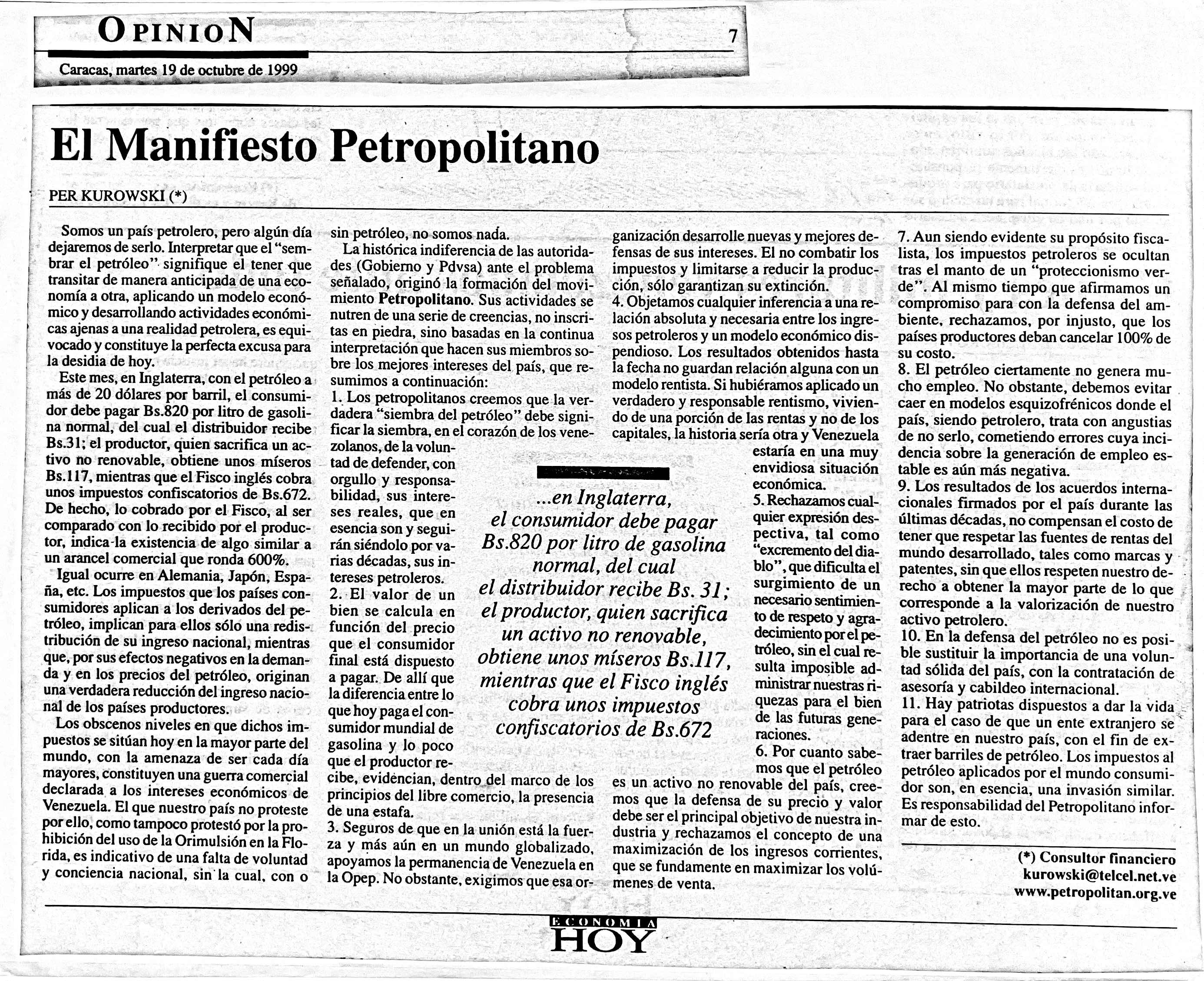
The Petropolitan Manifest
We are an oil country, but one day we will stop being one. Interpreting that “sowing oil” means having to move in advance from one economy to another, applying an economic model and developing economic activities unrelated to an oil reality, is wrong and constitutes the perfect excuse for today's apathy.
This month, in England, with oil at more than US$ 20 per barrel, the consumer must pay Bs. 820 per liter of normal gasoline, of which the distributor receives Bs. 31, the producer, who sacrifices a non-renewable asset, obtains a paltry Bs. 117, while the English Treasury charges confiscatory taxes of Bs. 672. In fact, what is charged by the Treasury, when compared with what is received by the producer, indicates the existence of something similar to a commercial tariff that is around 600%.
The same happens in Germany, Japan, Spain, etc. The taxes that consuming countries apply to petroleum products imply for them only a redistribution of their national income, while, due to their negative effects on the demand and prices of petroleum, they cause a real reduction in the national income of the producing countries.
The obscene levels at which these taxes are today in most of the world, with the threat of becoming higher every day, constitute a trade war declared against the economic interests of Venezuela. The fact that our country does not protest about this, just as it did not protest about the ban on the use of Orimulsion in Florida, is indicative of a lack of will and national conscience, without which, with or without oil, we are nothing.
The historical indifference of the authorities (Government and PDVSA) towards the aforementioned problem led to the formation of the PETROPOLITAN movement. Its activities are nourished by a series of beliefs, not inscribed on stones, but based on the continuous interpretation that its members make of the best interests of the country, which we summarize below:
We Petropolitans believe that the true “sowing of oil” must mean the sowing, in the hearts of Venezuelans, of the will to defend, with pride and responsibility, their real interests, which in essence are and will continue to be so for several decades, his oil interests.
1. We Petropolitans believe that the true “sowing of oil” must mean the sowing, in the hearts of Venezuelans, of the will to defend, with pride and responsibility, their real interests, which in essence are and will continue to be so for several decades, his oil interests.
2. The value of a good is calculated based on the price that the final consumer is willing to pay. Hence, the difference between what the world consumer of gasoline pays today and the little that the producer receives shows, within the framework of the principles of free trade, the presence of a scam.
3. Certain that there is strength in unity and even more so in a globalized world, we support Venezuela's permanence in OPEC. However, we demand that that organization develop new and better defenses of its interests. Not fighting taxes and limiting production only guarantees its extinction.
4. We object to any inference to an absolute and necessary relationship between oil revenues and a wasteful economic model. The results obtained to date have no relationship with a rentier model. If we had applied a true and responsible rentierism, living off a portion of the income and not the capital, the story would be different and Venezuela would be in a very envious economic situation.
5. We reject any derogatory expression, such as “devil's excrement”, which hinders the emergence of a necessary feeling of respect and gratitude for oil, without which it is impossible to manage our wealth for the good of future generations.
6. Since we know that oil is a non-renewable asset of the country, we believe that the defense of its price and value should be the main objective of our industry and we reject the concept of a maximization of current income, which is based on the maximize sales volumes.
7. Even though their fiscal purpose is evident, oil taxes are hidden behind the cloak of "green protectionism." At the same time that we affirm a commitment to the defense of the environment, we reject, as unfair, that the producing countries must pay 100% of their cost.
8. Oil certainly doesn't create many jobs. However, we must avoid falling into schizophrenic models where the country, being an oil producer, deals with the anguish of not being one, making mistakes whose impact on the generation of stable employment is even more negative.
9. The results of the international agreements signed by the country during the last decades do not compensate the cost of having to respect the sources of income of the developed world, such as trademarks and patents, without them respecting our right to obtain the majority of what corresponds to the valuation of our oil asset.
10. In the defense of oil, it is not possible to replace the importance of a solid will of the country, with the hiring of international advice and lobbying.
11. There are Patriots willing to give their lives in the event that a foreign entity enters our country, in order to extract barrels of oil. Oil taxes imposed by the consuming world are, in essence, a similar invasion. It is the responsibility of the Petropolitan to report this.
http://petropolitan.blogspot.com/1999/10/el-manifiesto-petropolitano.html