Thursday, June 26, 2008

Let us sit down and talk about oil!

On June 26, 2008 I published in Caracas an imaginary letter from Arnold Schwarzenegger to the citizens of Venezuela and in which he offers to buy, on a rolling five years average price, 2 million of oil barrels per day, so as to satisfy the needs of his California constituency and also to take the worst of that volatility out of the market that keeps his electorate running crazed between Hummers and hybrids.

To provide the Venezuelans with the incentives to entering into such a contract Arnold is offering to pay an equal share of the proceeds, to each one of the 26 million citizens of Venezuela, in the currency and in the account each one of them would order… instead of giving all that money to chávez.

Economics is about making the most out of scarce resources and so when seeing the oil suppliers in OPEP exercising their powers successfully, which is OK since oil in a non renewable resource and since the world at large should benefit from consuming less of it, one cannot help but ask why the consumers do not exploit their powers as consumers. I suspect because there are some not wanting them to do that.

I wonder what the Venezuelans would say if they would formally receive such an offer from Arnold since today the primary reason for which Venezuela is not exporting more oil, even though its citizens might need the money, is that its government gets more oil revenues than it can handle… in fact so much that they even give away some of the oil to London and Boston.

Fellow citizens from oil supplying and oil consuming countries, why do we not sit down and talk about it all, without intermediaries like oil companies or oil dictators?

Wednesday, March 21, 2007

Four Years and Counting in Iraq: Regarding "Lessons of War"

The Post should be commended for not describing the extremely difficult way forward in simplistic terms. Having said that, the editorial should have given more attention to the role of oil, not because of its obvious energy significance but because it is an obstacle to good governance in Iraq.
The editorial said, "We may have underestimated the impoverishment brought about by misrule and sanctions and the brutalization born of totalitarian cruelty." But the sentence should have continued: ". . . that thrives especially well in countries cursed by large amounts of oil revenue flowing to a central government, eliminating any chance for a sustainable democracy."
Coming from Venezuela, where oil revenue is centralized, I know that loyalties to country, tribe and sect are all irrelevant compared with the unnatural loyalty that can be purchased by those in control of a checkbook fattened by oil. If the United States wants to achieve anything going forward, it had better find a way to distribute Iraq's oil revenue directly to the Iraqi people.
Per Kurowski, Bethesda

Thursday, May 6, 2004

The desire to fail

SOMETIMES WE MUST teach students not to be afraid of success, said a teacher of color, with 32 years of experience in public schools in Washington. He is right, but in Venezuela we sometimes have to fight against the desire to fail. 
Globalization is something irreversible. Even the United States has had to give its arm to twist (or so it seems) and disconnect the subsidies, which artificially had kept a few of its cotton growers alive, at the expense of many other farmers in poor countries. 
For being a strong critic of the way Venezuela has handled globalization, it may be labeled as global-phobic, both by the inept, who do not realize their dangers, and by the snobs, who only see it as something elegant. However, the truth is that among those who fight, for Venezuela to succeed with globalization and those who believe that the country can have a better future, by turning its back on it, there is a world of differences. 
Recognizing that globalization is difficult and brings risks, we who accept the challenge of swimming with the currents and seeking to get the best for our nation, can feel some sympathy and understanding for those who truly believe we would be better off as hermits. Those who do not deserve our sympathy, understanding, or forgiveness though, are those who oppose globalization, only to ensure the failure of the country so to ensure that mediocrity that allows them to maintain their own share of power. 
In the long run, failure is not sustainable, neither in a globalized world, nor in a colonized one, or we succeed in our Venezuela, or some strangers will do so. In this sense, the failure-searchers, among which we will always find some who say they are acting on behalf of our nation, are cynically dedicated to losing it.
To those who on account of their good intentions believe the failure of their revolution is impossible, let me remind them that while it is difficult to maintain [the spirit of] a revolution without resources, it is much more so with an abundance that attracts all kinds of ilk.
To those who believe that everything will be fixed by just getting out of the process, beware! We can once again end up in total disillusion, not for fear of success, but for the desire to fail. 
To all those who believe that globalization will only leave losers, don't worry, every day there are more of us who want to make winners out of all. Let's not be afraid of success!
Translated from El Universal


Wednesday, December 24, 2003

The search for transparency in an oil-consuming world

Sir, There has been a lot of talk lately about a curse that, through corruption and other distortions, is stopping oil-rich countries from turning income into development. The Extractive Industries Transparency Initiative, championed by the United Kingdom and endorsed by the World Bank, has been named an exorcist and is starting the rites by applying a much-welcomed transparency to projects such as the Chad-Cameroon pipeline.

In the name of that same transparency, let us also remember that for every $1 received by any oil-producing country (which forever sacrifices a nonrenewable asset), the public treasury of many oil-consuming countries receives, net, at least $4 and is therefore a likely victim of the same curse, albeit stricken by different symptoms. For instance, in many oil-consuming developed countries, the curse has now created such an addiction to petrol taxes that their whole fiscal structures would be completely unsustainable without them.

Transparency would also, perhaps, not be a bad rite to use to exorcise this tax man’s curse, since most of the gasoline consumers in these countries are not remotely aware of the real extent of the taxes and much less of how the proceeds are used.

For instance, having been told that these taxes were environmental, they would be surprised to learn that probably less than 0.5 per cent of the 100,000 million dollars collected yearly in Europe, just in taxes on lead-free gasoline, goes to the environment; and, worse, that much of it goes in subsidies to the even less environmentally friendly coal.

Also, today, as the possibilities of satisfying the world’s demands for energy seem quite uncertain and the world becomes more aware that the ultimate cost of cutting, or not cutting, the trees of the Amazon will be paid by all, whether they like it or not, it is clear that the world needs to become much more penny-wise when developing alternative energies; and we all know that the best and only companion of the penny-wisest is transparency.

So, after the pipelines, when do we start with the Exchequer’s bag?


The Financial Times

Thursday, November 20, 2003

The curse

 The curse

Lately, articles that analyze the supposed curse that weighs on countries rich in oil resources have been published like rice. At first glance it would seem that there is a certain basis of support for these theories of obscurantism, however, for proper reading, it is important to clarify one or another detail.

First of all, and judging by the immense number of existing offers to free ourselves from this cursed burden, it is obvious that we are not talking about a common curse. There are even those who generously offer to assume their risks, even paying us for the right to such sacrifice.

A suggested exorcism is to leave OPEC to sell oil at its marginal extraction cost, thus guaranteeing that we avoid earning the dirty rent for oil. Another way is to privatize it, against a tasty and tempting initial payment, to cancel the current public debt... and get into debt again? As you can see, both methods have a strange similarity with selling the sofa.

Finally, considering that the European treasury earns about 100 dollars net per barrel, while those who sacrifice the resource only get 25 dollars, gross, it is not very obvious who is the cursed one.

The indisputable thing is that oil revenues have not been used well, but as you can understand, this has less to do with the abundance of resources and more to do with the damn system used to distribute them. Currently, the entire oil revenue enters the government's coffers alone and effortlessly, thus unbalancing the democratic system, since we all know that the happy holder of a full oil checkbook has little incentive to pay attention to the citizen.

How do we get out of this? To begin with and due to the obvious and incurable lack of talents of our rulers, we must apply the parable of the talents in reverse and bypass them, delegating a greater part of the administration of oil revenues directly to the citizens.

However, since we civil society members are not very different from our politicians, like-minded, like-minded, perhaps we should, just in case, pay the oil dividends with educational tickets.

Chances of it? Few, due to that true curse, the one that leads our leaders to believe that everything bad in the past is miraculously cured with their arrival in power (with the checkbook) and, us, to believe them.

Translated by Google

https://petropolitan.blogspot.com/2003/11/la-maldicion.html


On Transparency and Curses

Lately there has been a lot of talk about a curse that, through corruption and other distortions, is stopping oil-rich countries from turning income into development. The Extractive Industries Transparency Initiative, championed by the UK and endorsed by the World Bank, has been named exorcist and is starting its rites by applying a much welcomed transparency to projects such as the Chad-Cameroon pipeline.

In the name of that same transparency, let us also remember that for every single dollar received gross by any oil producing country (who forever sacrifices a non-renewable asset), the public treasury of many oil consuming countries receives, net, at least four dollars, and is therefore a likely victim of the same curse, albeit stricken by different symptoms. For instance, in the oil-consuming developed countries, the curse has now created such an addiction to gasoline taxes, that their whole fiscal structures would be completely unsustainable without them.

To exorcise the taxman’s curse transparency would also be a good starting point as most of the consumers in these countries are not remotely aware of the real extent of the gasoline taxes, and even less of how the proceeds are used. For instance, having always been told that these taxes were environmental, they would be surprised to learn that probably less than half a percent of the US$100 billion collected yearly in Europe, just in taxes on lead-free gasoline, goes to the environment and, worse, that much of it goes in subsidies to the even less environmentally-friendly coal.

Also, today, as the possibilities of satisfying the world’s demands of energy seem quite uncertain and the world is becoming more aware of the final cost of cutting or not the trees of the Amazon will be paid by all, whether they like it or not, it is clear that the world needs to become much more penny-wise when developing alternative energies… and we all know that the penny-wisest best and sole companion, is transparency.

So, after the pipelines, when do we start with the Exchequer’s bag?

Thursday, June 7, 2001

The Oil Referendum

WOULD YOU BE IN AGREEMENT if the Bolivarian Republic of Venezuela were to sign an oil contract with the United States of America (U.S.A.) under the following conditions?
The U.S.A. and Venezuela agree that starting today and for the next 50 years, the U.S.A. would buy and Venezuela would sell three million barrels of oil per day with Venezuelan characteristics. The Reference Price (RP) would be US $25 per barrel, indexed to the U.S.A. inflation rate, plus or minus an adjustment equivalent to 50% of the difference between the RP and the spot-market price.
As a consideration, Venezuela would also keep an additional 2 million barrels per day at the preferential availability of the U.S.A., which could be bought by the U.S.A. at spot-market prices, provided there were an emergency that made those prices exceed the RP by at least 100%.
In order to guarantee to the U.S.A. that Venezuela would always be in a position to meet its supply obligations, Venezuela would agree that it would not, under any circumstances, contract a new public debt, so as to make sure that the oil revenues to be received over the next 50 years would not be given as guarantees for new fresh loans today, and thereby risk wiping away the value of those reserves in a mere 50 days.
In order to ensure the enthusiastic applause of environmentalists, Venezuela would earmark 3% of oil revenues to planting trees in our country, trees which would capture carbon from oil emissions.
In order to ensure that the Venezuelan citizenry would get its fair share of the revenues (and vote “YES”), 30% of Venezuela’s gross oil revenues would be directly distributed in equal amounts to each Venezuelan. That distribution could be made in cash or in vouchers for health and education services.
If the “YES” vote were to win the hypothetical referendum described above, Venezuela would have macroeconomic stability, enabling it to formulate a true development plan, and the U.S.A. would have a larger, more secure supply of energy.
But so long as the natural market for our oil, the United States of America, remains incapable of gauging its interests beyond the current quarter, and doesn’t care if oil falls to 7 dollars a barrel, and prefers to create costly strategic reserves by burying crude oil or exploiting environmentally delicate areas, then any Venezuelan president trying to defend his or her country and keep the price of oil somewhere above the miserable marginal cost of extraction has no alternative but to strengthen OPEC and seek alternatives elsewhere, if for no other reason than to incite jealousy.
To the best of my understanding, this is what geopolitics is all about; and that’s why it might not be such a bad idea for the United States to study realpolitik—especially when, as happened forty years ago on a Caribbean island, they flunked that subject royally.
Published in El Universal, Caracas, June 7, 2001 (The links to my articles have been erased)
P.S. The above is what I wrote in 2001, but no one in the U.S.A. picked up on the idea or proposed anything similar. That is why today, when oil is up around 60 dollars, I don’t care a lot about some of the crybabies.
P.S. Now, in 2009, after having seen another oil-boom gone to naught in my country I would as a citizen not settle for the 30% mentioned above but request 90%, not in vouchers but in cash!


Thursday, February 1, 2001

No, thanks

No, thanks
The following paragraph is extracted verbatim from the UK Energy Report 1999, published by the Department of Trade and Industry of England.
“The retail price of products is largely determined by taxes, especially for fuel. The attached figures ... illustrate the increasing proportion of the price of gasoline attributable to taxes. The incidence of taxes, ...explains around 85 percent of the final price of unleaded gasoline..." Prices are expected to continue growing, given the commitment of the English Government to increase taxes on petroleum by an average of 6 % annual, above inflation.
The report's figures indicate that the price of petrol before tax fell from 15 to 10 pence per liter between 1980 and 1999, a decrease of 33%. However, for the same period in England, the consumer price went from 26 to 68 pence per liter, increasing 162%. The explanation for this phenomenon is found in the various taxes on gasoline, which rose from 11 pence in 1980 to 58 pence per liter in 1999, an increase of 427%.
Taxes, applied in a discriminatory manner to oil, which favor coal, for example, affect both the volume and the sales price of our main export product and therefore directly harm our country. All of Europe applies taxes of the same order and the other consuming economies, except the United States, are evolving in the same direction.
It was only a few months ago that the magnitude of these taxes was understood and the consequences, at least in Europe, were serious protests by consumers. It will be necessary to observe whether in 2001, countries like England and Germany, even when stripped, continue with their pre-programmed increases.
The relative silence of Venezuela and other oil-producing countries, the truly aggrieved ones, is surprising. Sometimes I wonder if such passivity has its origin in the fact that in this globalized world, everyone is still dying for the possibility that one day The Queen will invite them to have tea in her palace.
In November 2000, the president of the European Energy Foundation of the European Union, with great cynicism, announced that in the dialogue between oil consumers and producers, everything could be discussed, except taxes, since these did not significantly affect consumption.
In December 2000, the European Union announced a donation of 55 million euros for the reconstruction of Vargas, to be disbursed over two years.
In a world that preaches free trade, oil taxes are hypocrisy. I, being a Venezuelan of European descent, may react in particular, but I am convinced that we have to place our protest in its correct dimension. In this sense, and even if I had never rejected the help offered by the United States during the tragedy in Vargas, today I would not hesitate to respond to Europe: No thanks, we do not want your donation, that amount is equivalent to what Venezuela would obtain each week if You, on the basis of false environmentalism and real fiscal voracity, do not apply taxes that discriminate against oil. We will not help calm their institutional conscience by accepting some insolent barter with begging mirrors.

(Translated by Google from an Op-Ed published in Venezuela February 1, 2001)


Thursday, August 3, 2000

Kohlenweiss 1979

It’s been twenty years, and the deadline established to keep the minutes of the European Union (EU) Inter-Ministerial meeting secret has elapsed. At last, we can read what was agreed to in the small German town of Kohlenweiss during a rainy autumn weekend in 1979, when EU Energy Ministers met in conclave to draw up a strategy on “how to defend oneself from the crude rent aspirations on crude of OPEC countries.”
One debate registered in the minutes seems particularly horrible with all its prejudices against oil-exporting countries. However, because of lack of space, I will limit myself to summing up the approved plan, as originally presented by German minister Grüngelde, a plan that allegedly hinged on the following five key actions.
The first measure (the most innocuous) was to strengthen the relations between European governments and the environmental organizations to such a degree that the latter could be used to apply pressure in favor of diminishing oil consumption without its affecting the more contaminating coal, which Europe happened to possess.
Secondly, a program of continued hikes in taxes on oil and its derivatives, especially gasoline, was established to ensure not only a drop in demand but also that day after day the oil producers would receive a lesser and lesser proportion of oil's real value in the final market, namely, the price paid by the consumer. In this respect, the countries pledged themselves not to allow a lowering of gas prices to the consumer so, each fall in the price of crude should set off an immediate increase in taxes.
The third course of action was aimed at weakening OPEC's internal cohesion and in that sense, using Cold War tactics (the Berlin Wall hadn't tumbled yet), disinformation was one of the recommended instruments, aimed principally at sowing doubts and suspicions inside OPEC itself regarding such things as compliance with quotas set by the organization.
The fourth element agreed to was the “Community’s prior interest to promote and support efforts that would lead to the privatization of the oil industry in OPEC countries.” The reasons are understandable, when among the arguments, is that “as long as the oil industry belongs to the states, they will have the possibility of brandishing the weapon of geopolitical bargaining.” The report established that “to achieve the goal of privatization, the ensuing competition among the partners would guarantee greater volumes of production and lower prices, in view of the fact that they all have a common interest in increasing profit and cash flow in the short term.”
The Fifth ...? Why continue?

I admit the above is pure fiction and that, as far as I know, it doesn’t exist except in my imagination. There’s no Kohlenweiss or Grüngelde. I have no knowledge of any such meeting and I definitely don’t believe that the European Union fixed a period of only twenty years to make documents of this kind public.
However, since reality is stronger than fiction, I trust the reader will pardon my cheek. Let’s see:
Since 1980 all taxes on oil and derivative have been hiked. For example, in the United Kingdom they went from 85% added value in 1980 to a confiscatory 456% in 1998. Obviously, during the same period oil products price index on the consumer level increased in the UK in constant terms from 100% to 247%, while, as if it were planned, the crude oil price index fell from 100% to a miserable 18%.
A barrel of oil contains around 160 liters of oil products broken down into gasoline (84), jet fuel (12), gas oil (36), lubricants (16) and heavy residuals (12). Today, when oil in Europe sells at a minimum $1.20 per liter, we see that this component represents more than $100—adding the other derivatives we come to a market value, that is, the price the consumer is prepared to pay, of more than $150 per barrel. If we start from the fact that refining, transport, and distribution costs aren’t high, let’s say around $20 per barrel, we can conclude that the European Treasury retains a minimum of $100 per barrel, while the producer, who actually sells an asset and sacrifices a nonrenewable resource, has to be satisfied with $30—scarcely 20% of its European value.
As for cooperation with environmental movements, there’s no doubt it’s been a complete success, since oil has been punished with all kinds of possible taxes, thus diminishing its consumption, while coal hasn't been touched even with a feather, arriving at the absurd situation where it’s even being subsidized in some countries by taxes on oil. The consequence of such disparity in treatment can be seen in International Energy Agency statistics, which indicate that in 1973 oil accounted for 44.9% of world fuel consumption compared to 35.3% in 1996. Coal consumption in 1973 represented 24.8% and had maintained the same percentage in 1996.
Despite the fact that the figures mentioned above show clearly that only through geopolitical instruments like OPEC can existing injustice be reversed or at least cushioned, in Venezuela privatization has not only been preached until the beginning of 1999 but it has also been partially achieved through Apertura Petrolera (Oil Opening).
Another trick was to egg us on to believe that the solution lay in increasing the volume of production, even though the price was $8 per barrel, 5 cents for each liter (less than bottled water), a price that hardly covers the costs of extraction. Pressures to increase production were so intense that they continue even today, when we see important representatives of our local academe propose a weird thesis, according to which if Venezuela produces 3 million barrels of oil per day and sells it at $30 a barrel, we will find ourselves in the immoral grip of living on rents whereas, if, on the contrary, we produce 7 million barrels a day and sell it for just $7 a barrel, it would reflect an immense and praiseworthy productive effort.
Finally, with respect to OPEC, we can only say it has just saved itself from extinction—for the time being.
With this on record, who can doubt that, in fact, I have produced enough material to inspire a thriller script? If anyone out of curiosity wants to know what the imaginary Kohlenweiss fifth pillar was in the hope that (as my daughters say) recounting a nightmare makes sure it will never happen, I confess that recently I have been waking up each morning bathed in nervous sweat, fresh from the nightmare that the EU has plotted to plant an environmental extremist in the White House.
From El Universal, Caracas, August 3, 2000

And published in OGEL too


Friday, March 24, 2000

Oil and the Stockholm Syndrome

Fact No. 1: In 1980 the nominal price of oil (Arabian Light) was US$ 36 per barrel. In constant dollar prices calculated using the GDP deflator with 1998 as base, this was equivalent to US$ 67. By the end of 1998 the price of oil was US$ 12.20. In real terms it means that if the price index of oil in 1980 was 100% then in 1998 it was only 18%.
Fact No. 2: The index of oil products retail prices in 1980 was equal to 100%, in the United Kingdom, it reached 247% in 1998.
Fact No. 3: The amazing difference in how the two oil-related indexes developed can only be explained by taxes. As an example, in the UK in 1980 the ad-valorem taxes on gasoline were 85%; at the end of 1998 the same taxes were 456%.
Conclusion. Oil demand and oil prices are being held hostage by the taxes levied on various oil products by most oil-consuming countries. Had it not been for these sky-high discriminatory taxes, Venezuela would today be selling more oil at higher prices, easily repaying its foreign borrowings, and not even requiring a credit rating.
Adding insult to injury, the before mentioned taxes were slammed on Venezuela's main export at a time when the country was busy reducing custom duties and opening up its economy to all type of foreign competition.
It is difficult, then, to understand why, thanks to their country’s press, radio and television, Venezuelans can only worry and feel guilty of the fact that perhaps the recent increases in the price of oil will be the detonator for inflation and worldwide recession.
Could it be that the Stockholm syndrome affects Venezuela (as well as all of the OPEC nations)? As all pseudo-psychologists and writers should know, the Stockholm syndrome is what happens when someone that has been kidnapped finally becomes sympathetic with the position of his captors and ultimately even begins to defend them.
If you doubt what I am saying, just think of how our neoliberals, while talking up the maximization of income as one of their credos, blithely forgive their foreign heroes by either ignoring the issue or by creating lame environmental excuses or by simply repeating absurdities as “being rentist is really not very good for the country”. I would specially like to see them sustain this last thesis in other countries, for example in those that do all that is possible to maximize their rent from intellectual property, to the point of turning us into their best collectors.
That’s it then. There is no doubt in my mind that the Stockholm syndrome, or something very similar, is alive and well in Venezuela’s economic policies.
We need a couple of couch sessions, this time with psychologists that are very different from those we have used up to now. Dr. International Monetary Freund turned out to be simply an unethical Dr. Fraud. While the latter was pretending to give us good advice, he would travel behind our backs throughout the world, preaching the marvels of increasing taxes on oil-based products, and when this was not sufficiently convincing, simply forcing the adoption of the policy.
With its inaction, OPEC is also a prime suspect of having come down with the same affliction. I sure hope that during their sessions next week, to be held in Vienna, they will find time to get the advice of a true Dr. Freud.
Only then will they realize that at US$ 30 per barrel, the price of oil is still less than 45% of what it was in 1980.
Only then will they be able to understand the true injustice present when a taxman of a consumer country perceives an income 4.8 times more than the producer of a non renewable asset. During February this year, premium unleaded gasoline was sold at the pump in the UK for US$ 1.18 per liter, distributed as follows: 20 cts for the producer, 5 cts for the distributor and 93 cts for the British taxman.
Only then will they know that the world is not threatened by oil prices. The world and economic growth is above all, threatened by taxes implement for the sake of easy tax collection.
Only then will they remember to ask for a reduction of oil taxes, as a quid-pro-quo for any increase in oil production.
OPEC friends, … please remember Stockholm.
Calculations based on information in World Oil Trends 1999 published by Arthur Andersen and Cambridge Energy Research Associates.


Tuesday, October 19, 1999

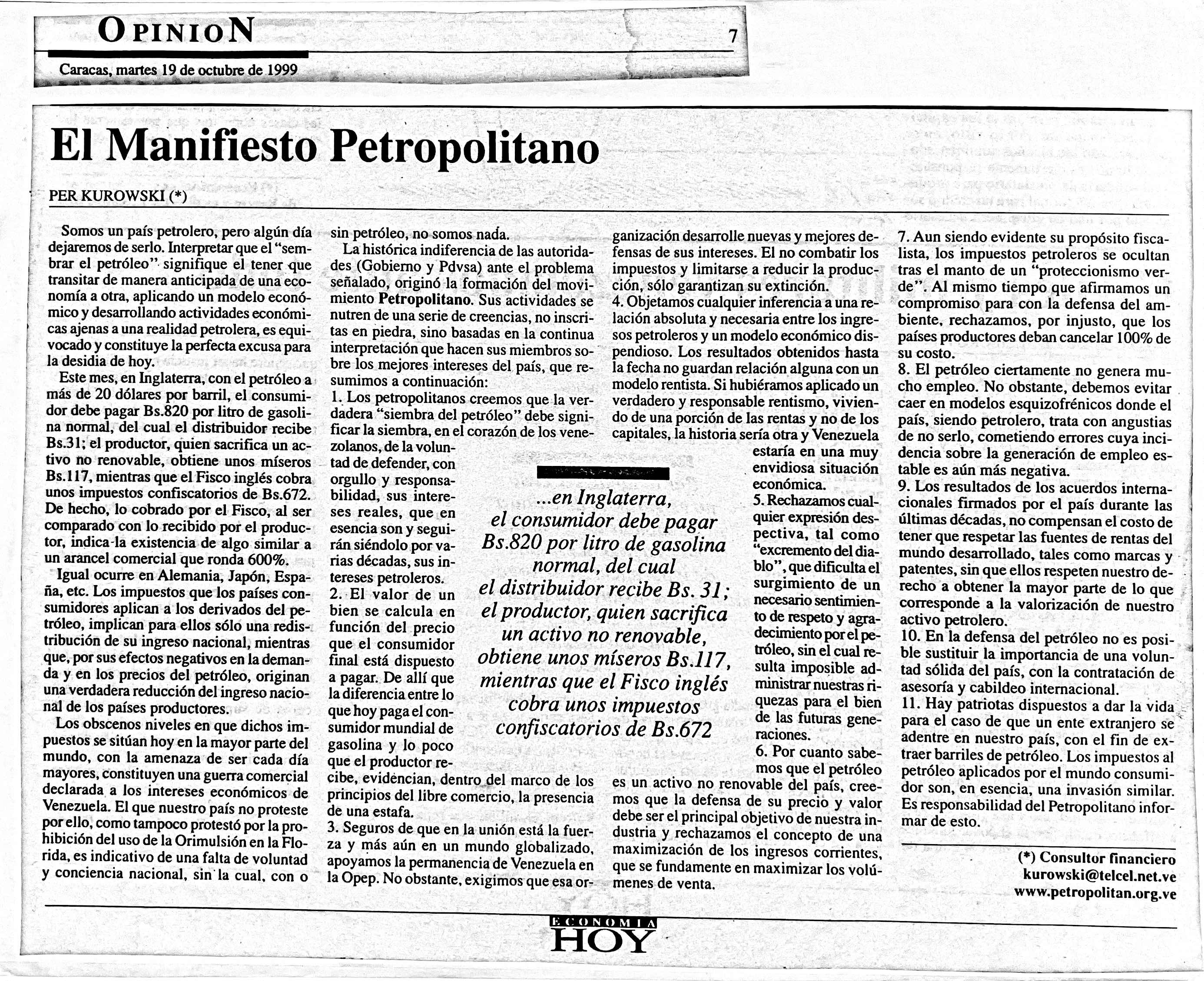
The Petropolitan Manifest

 The Petropolitan Manifest

We are an oil country, but one day we will stop being one. Interpreting that “sowing oil” means having to move in advance from one economy to another, applying an economic model and developing economic activities unrelated to an oil reality, is wrong and constitutes the perfect excuse for today's apathy.


This month, in England, with oil at more than US$ 20 per barrel, the consumer must pay Bs. 820 per liter of normal gasoline, of which the distributor receives Bs. 31, the producer, who sacrifices a non-renewable asset, obtains a paltry Bs. 117, while the English Treasury charges confiscatory taxes of Bs. 672. In fact, what is charged by the Treasury, when compared with what is received by the producer, indicates the existence of something similar to a commercial tariff that is around 600%.


The same happens in Germany, Japan, Spain, etc. The taxes that consuming countries apply to petroleum products imply for them only a redistribution of their national income, while, due to their negative effects on the demand and prices of petroleum, they cause a real reduction in the national income of the producing countries.


The obscene levels at which these taxes are today in most of the world, with the threat of becoming higher every day, constitute a trade war declared against the economic interests of Venezuela. The fact that our country does not protest about this, just as it did not protest about the ban on the use of Orimulsion in Florida, is indicative of a lack of will and national conscience, without which, with or without oil, we are nothing.


The historical indifference of the authorities (Government and PDVSA) towards the aforementioned problem led to the formation of the PETROPOLITAN movement. Its activities are nourished by a series of beliefs, not inscribed on stones, but based on the continuous interpretation that its members make of the best interests of the country, which we summarize below:


We Petropolitans believe that the true “sowing of oil” must mean the sowing, in the hearts of Venezuelans, of the will to defend, with pride and responsibility, their real interests, which in essence are and will continue to be so for several decades, his oil interests.


1. We Petropolitans believe that the true “sowing of oil” must mean the sowing, in the hearts of Venezuelans, of the will to defend, with pride and responsibility, their real interests, which in essence are and will continue to be so for several decades, his oil interests.


2. The value of a good is calculated based on the price that the final consumer is willing to pay. Hence, the difference between what the world consumer of gasoline pays today and the little that the producer receives shows, within the framework of the principles of free trade, the presence of a scam.


3. Certain that there is strength in unity and even more so in a globalized world, we support Venezuela's permanence in OPEC. However, we demand that that organization develop new and better defenses of its interests. Not fighting taxes and limiting production only guarantees its extinction.


4. We object to any inference to an absolute and necessary relationship between oil revenues and a wasteful economic model. The results obtained to date have no relationship with a rentier model. If we had applied a true and responsible rentierism, living off a portion of the income and not the capital, the story would be different and Venezuela would be in a very envious economic situation.


5. We reject any derogatory expression, such as “devil's excrement”, which hinders the emergence of a necessary feeling of respect and gratitude for oil, without which it is impossible to manage our wealth for the good of future generations.


6. Since we know that oil is a non-renewable asset of the country, we believe that the defense of its price and value should be the main objective of our industry and we reject the concept of a maximization of current income, which is based on the maximize sales volumes.


7. Even though their fiscal purpose is evident, oil taxes are hidden behind the cloak of "green protectionism." At the same time that we affirm a commitment to the defense of the environment, we reject, as unfair, that the producing countries must pay 100% of their cost.


8. Oil certainly doesn't create many jobs. However, we must avoid falling into schizophrenic models where the country, being an oil producer, deals with the anguish of not being one, making mistakes whose impact on the generation of stable employment is even more negative.


9. The results of the international agreements signed by the country during the last decades do not compensate the cost of having to respect the sources of income of the developed world, such as trademarks and patents, without them respecting our right to obtain the majority of what corresponds to the valuation of our oil asset.


10. In the defense of oil, it is not possible to replace the importance of a solid will of the country, with the hiring of international advice and lobbying.


11. There are Patriots willing to give their lives in the event that a foreign entity enters our country, in order to extract barrels of oil. Oil taxes imposed by the consuming world are, in essence, a similar invasion. It is the responsibility of the Petropolitan to report this.


http://petropolitan.blogspot.com/1999/10/el-manifiesto-petropolitano.html